
Most running injuries do not happen suddenly. They announce themselves weeks in advance. The problem is not that the warning signs are subtle. It is that we are not looking in the right places. And when we do spot something, we explain it away. A bad night of sleep. A stressful week at work. That heavy-legged feeling that will probably pass by tomorrow. Sometimes it does pass. But often, it is your body beginning a predictable sequence that ends in a forced rest, a DNF, or a longer injury than you planned for. This post is about learning to read those early warning signs, in your physiology, your training load, and your running form, before they become a problem that cannot be ignored.
The Overtraining Cascade
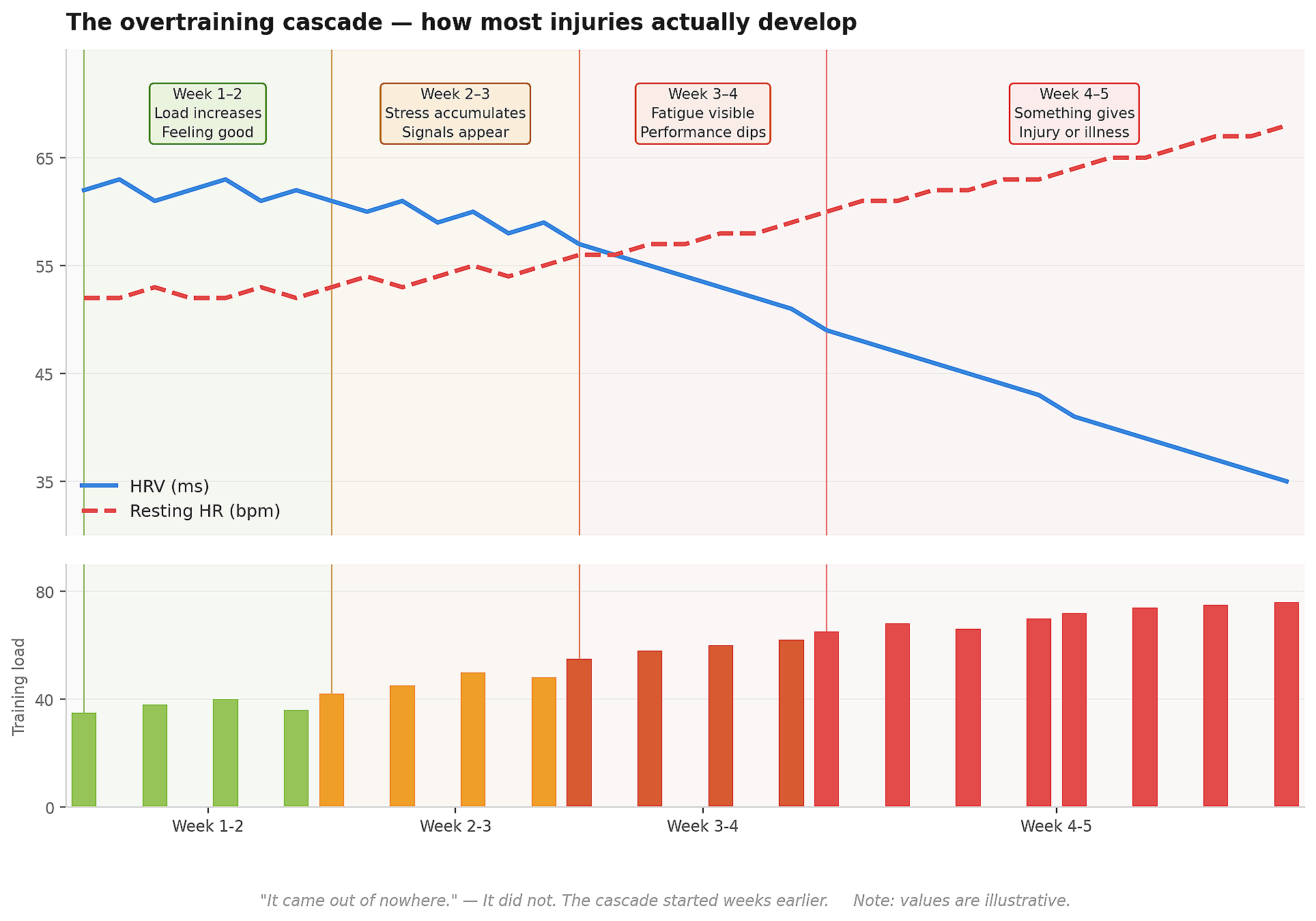
Overtraining does not arrive all at once. It builds through a recognisable progression.
Week 1 or 2: Load increases. Maybe you are building toward a race. Maybe you squeezed in an extra session. Maybe you ran faster than planned on a day that was supposed to be easy. Your body is handling it. You feel good. Things feel like they are clicking.
Week 2 or 3: Physiological stress accumulates. Your HRV starts to show slight day-to-day variability. Your resting heart rate might creep up a beat or two. Sleep quality dips. You are still training, still feeling mostly okay, but the signals are there if you are looking.
Week 3 or 4: The fatigue becomes harder to ignore. Performance plateaus or drops slightly. Motivation dips. You feel flat on runs that should feel manageable. Recovery between sessions gets slower. The gap between your acute and chronic training load has become significant.
Week 4 or 5: Something gives. A muscle that has been compensating for altered form for weeks finally says no. Or your immune system, depressed from sustained stress, lets an illness through. Or you push through a session your body was not ready for and the accumulated load tips over into injury. At this point, most runners say it came out of nowhere. It did not. The cascade started weeks earlier.
Early Warning Signs
The physiological signals come first.
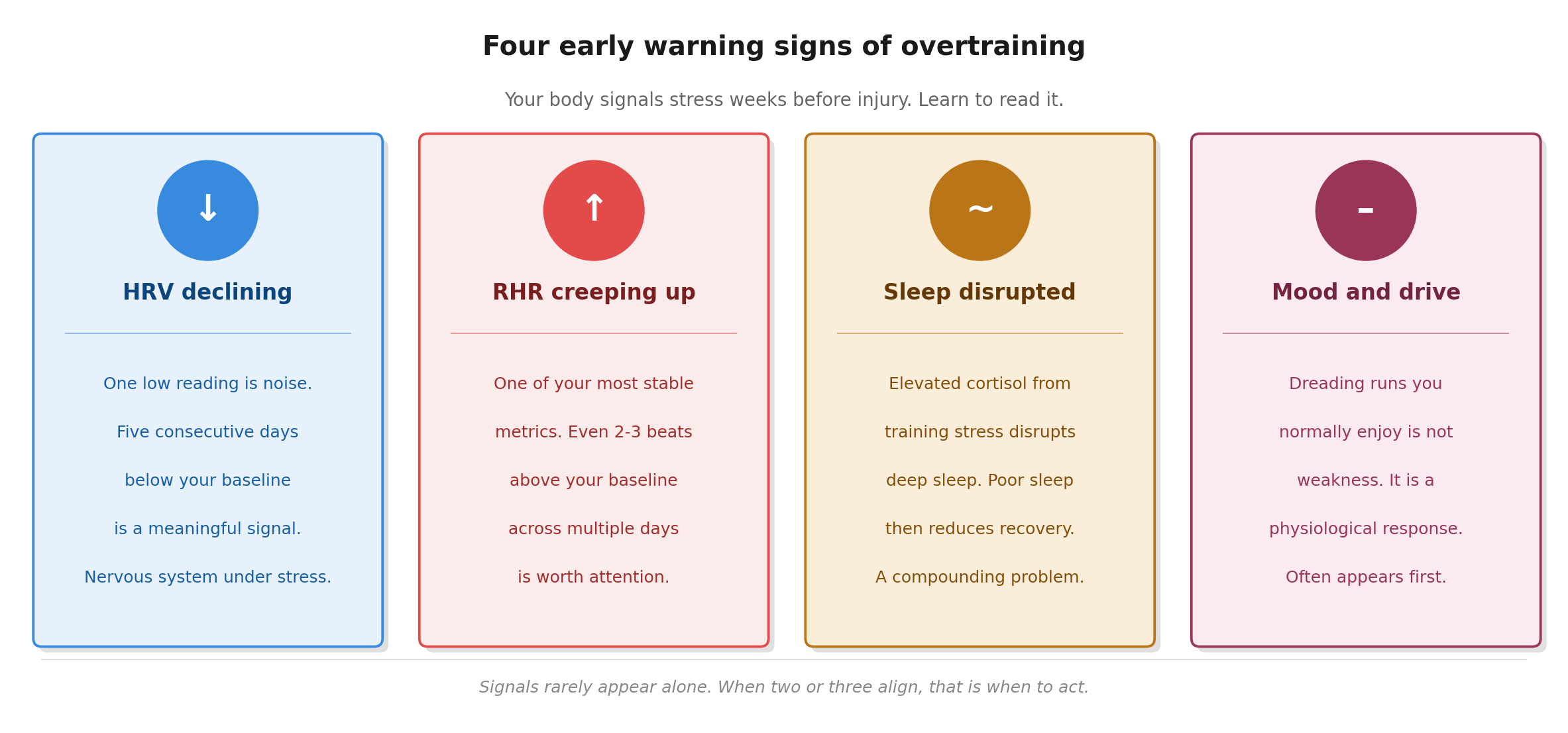
HRV decline over multiple days. A single low HRV reading is usually noise. A bad night, a stressful day, alcohol the evening before. But a consistent decline over five or more days is a meaningful signal. Your nervous system is under sustained stress and not recovering between sessions. The key word is trend. One data point is not a trend. Five consecutive days of readings below your baseline is a trend.
Resting heart rate creep. Your resting heart rate is one of the most stable metrics in your Apple Health data. When it starts climbing, even by two or three beats per minute above your normal baseline, it is worth paying attention. A rising RHR across multiple days, especially combined with declining HRV, is a classic overreaching pattern.
Sleep disruption. Overtraining disrupts sleep. This is partly physiological. Elevated cortisol from training stress interferes with the hormonal processes that regulate deep sleep. And poor sleep then reduces your recovery capacity, which compounds the problem. If your sleep quality is dropping without an obvious external cause, consider whether your training load might be the reason.
Mood and motivation. Persistent fatigue, unusual irritability, and a loss of enthusiasm for training you normally enjoy are not signs of weakness or a bad attitude. They are legitimate physiological responses to accumulated training stress. Research on overtraining syndrome consistently identifies mood changes as an early indicator, often appearing before significant performance decline. If you dread runs you normally look forward to, take that seriously.
The Biomechanics Angle
This is the warning sign most runners miss entirely because they are not measuring it. When your body is fatigued, your running form changes before your pace does. The neuromuscular system starts to break down, your muscles lose their ability to generate force efficiently, and your gait adapts to compensate. These adaptations protect you in the short term but increase injury risk if they persist.
Cadence drops. Running cadence, the number of steps per minute, tends to fall when you are fatigued. Your stride lengthens as you push for the same pace with less efficient mechanics. Lower cadence means more time in the air per stride and a harder landing, which increases impact forces on your joints. A runner whose cadence has dropped 4-5% over two weeks, even on easy runs, is showing signs of neuromuscular fatigue. This is invisible in pace-only data.
Ground contact time. Ground contact time measures how long your foot is in contact with the ground during each stride. When you are fresh, contact time is short. Your muscles generate force quickly and efficiently. When fatigued, contact time increases. You are spending more time on each foot, which is less economical and adds load to the structures absorbing impact.
Left-right balance. Perfect symmetry between left and right is rare and not necessarily the goal. But significant asymmetry, particularly asymmetry that appears or worsens during a run, can flag compensation patterns. When one side is doing more work than the other, it is compensating for weakness or fatigue elsewhere. Over time, this creates conditions for overuse injury on the side taking more load.
How to Catch It
A simple daily framework. Each morning, before you decide how to train, run through five questions:
How is my HRV compared to my 7-day baseline? Down more than 10-15%? Pay attention.
Is my resting heart rate elevated? Above my recent average by 2-3 beats? Note it.
How did I sleep? Duration and quality both matter.
How do I feel? Energy, mood, motivation. Be honest.
What does my training load look like? Have I increased load significantly this week?
No single signal makes a verdict. The pattern across all five does. On any given day, one of these might look off. That is normal. When three or four of them are pointing in the same direction, that is when to act.
ADAPT versus RECOVER
Not every warning day needs complete rest. The distinction matters.
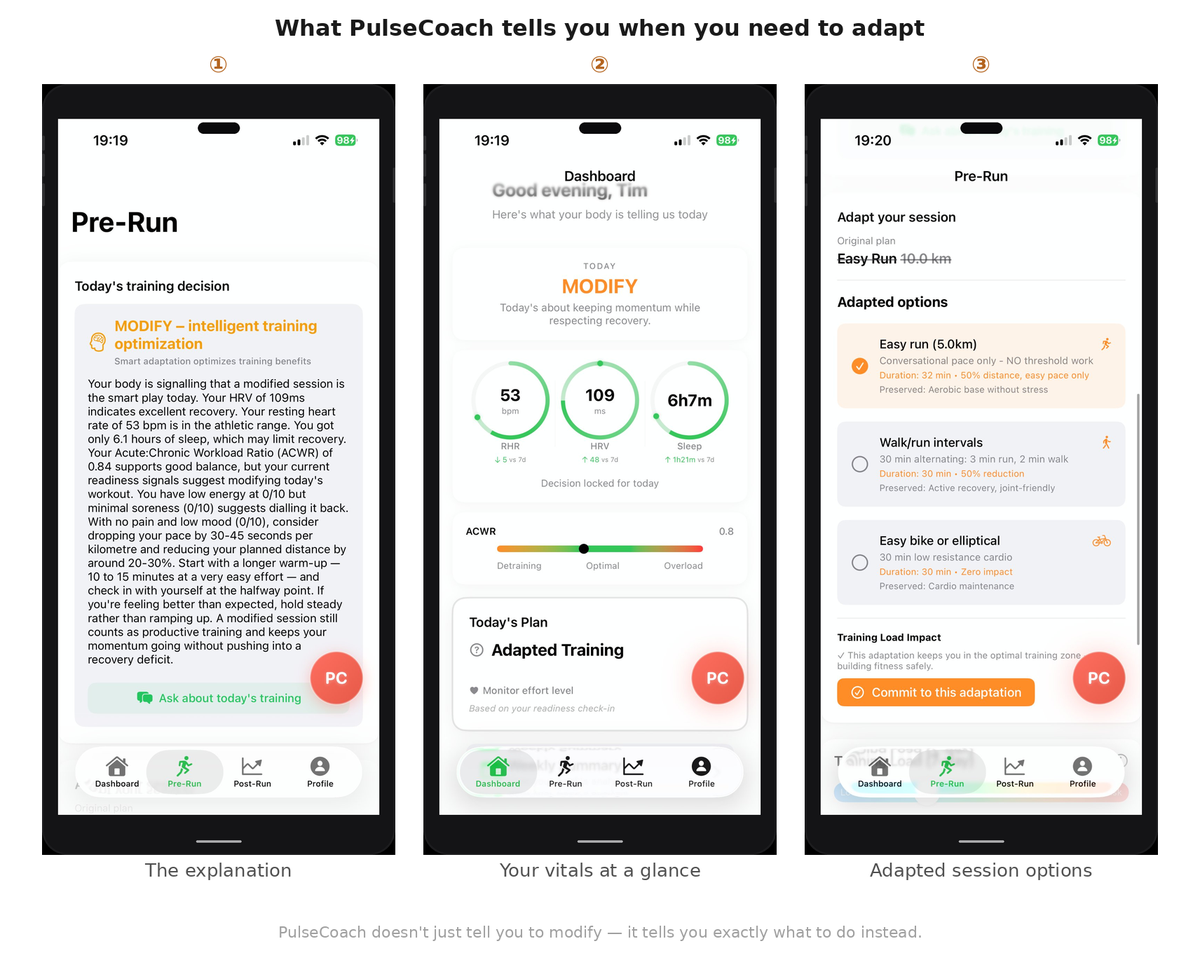
ADAPT means your body is under some stress but not enough to stop. Keep moving. Reduce intensity and duration. An easy 30-minute run at genuine conversational pace. No tempos, no intervals, no pushing.
RECOVER means your body needs genuine rest from hard training. An easy walk, gentle mobility work, or a slow jog is fine. It means no training stress today.
The mistake most runners make is treating all recovery the same. Some days need ADAPT. Some days need RECOVER. Getting this distinction right makes a material difference.
The ACWR Framework
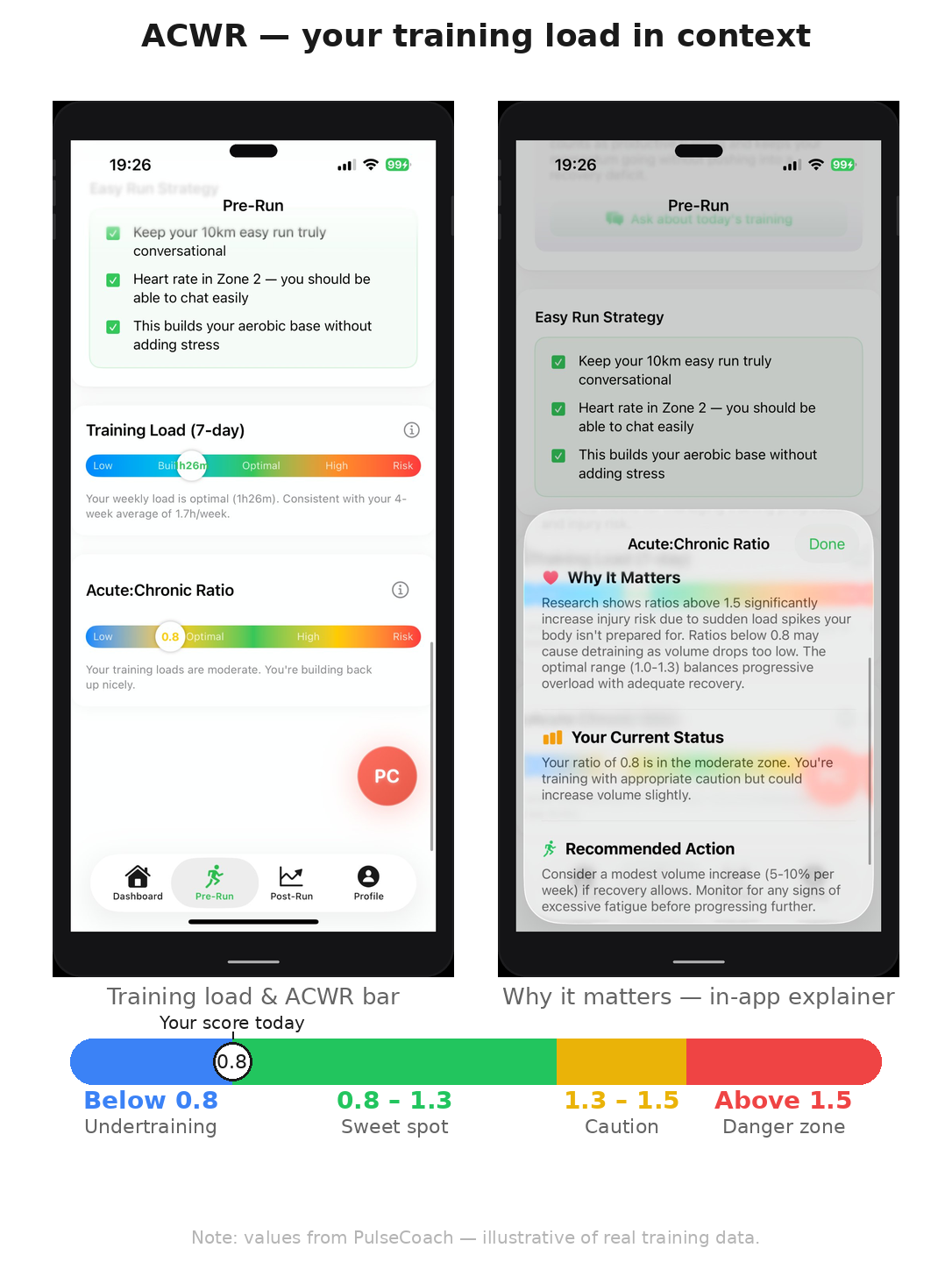
Your Acute to Chronic Workload Ratio is the ratio of your training in the past 7 days to your average weekly training over the past 28 days.
Above 1.5: You have ramped load too quickly. Injury risk is elevated regardless of how you feel.
0.8 to 1.3: Safe zone. Load is consistent with your training history.
The most dangerous time for overtraining injury is not during a sustained heavy block. It is during a sudden spike: returning from illness and jumping back to full training, squeezing in extra sessions before a race, or responding to a missed week by doing too much too soon. Keep an eye on your weekly ACWR. A sudden jump above 1.3 is a yellow flag. Above 1.5 is a red one.
Conclusion
Overtraining injuries do not come from one bad session. They come from ignoring a series of quiet signals over weeks. Your body is communicating with you constantly, through HRV, resting heart rate, sleep quality, mood, form, and training load. Most of that information is already sitting in your Apple Health data, uncollected and unused. The goal is not to become obsessed with numbers. The goal is a simple, reliable system that surfaces the signals that matter and tells you what to do about them. Listen to the early whispers. You do not want to wait until they become a shout. If this was useful, share it with a runner who trains hard and keeps getting hurt.